
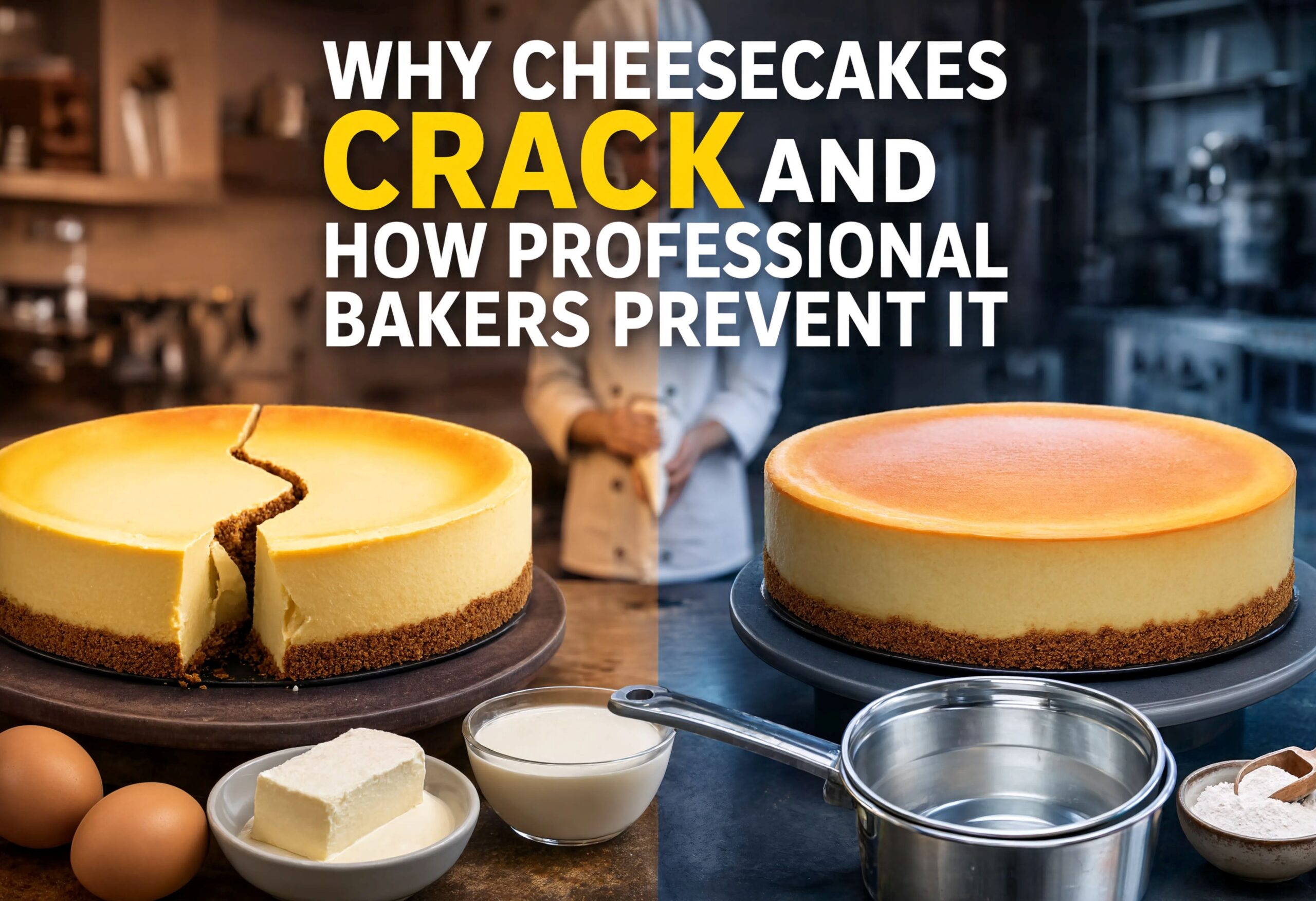
Introduction
Few baking disappointments are as frustrating as pulling a beautiful cheesecake from the oven only to discover a deep crack running across the surface. I have baked hundreds of cheesecakes over the years, from classic New York-style versions to delicate ricotta and Basque-inspired varieties, and cracking remains one of the most misunderstood problems in baking. Many home bakers assume cracks are caused by a bad recipe, poor-quality ingredients, or simple bad luck. In reality, cheesecake cracks are almost always the result of predictable physical and chemical reactions that occur during baking and cooling.
What makes cheesecake particularly challenging is that it behaves differently from most cakes. Instead of relying heavily on flour and chemical leaveners, cheesecake is essentially a baked custard. Its structure depends primarily on proteins from eggs and dairy, which react very sensitively to heat. Small changes in oven temperature, mixing technique, or cooling conditions can dramatically affect the final texture and appearance.
In my kitchen, understanding the science behind cheesecake has eliminated nearly every cracking issue. By learning how proteins coagulate, how moisture moves through the batter, and how temperature affects expansion and contraction, you can consistently produce smooth, bakery-quality cheesecakes. By the end of this guide, you will understand exactly why cheesecakes crack, how professionals prevent it, and what to do if problems appear during baking.
The Underlying Science Behind Cheesecake Cracks
To understand cheesecake cracking, it helps to think of cheesecake as a custard rather than a cake. The primary structural ingredients are cream cheese, eggs, and dairy. When heated, the proteins in these ingredients unfold and bond together in a process known as coagulation. This network of proteins gives cheesecake its signature sliceable texture.
The problem begins when the proteins become too hot. Egg proteins start setting at relatively low temperatures and continue tightening as heat increases. When a cheesecake exceeds its ideal internal temperature range, the protein network contracts aggressively. This contraction forces moisture out of the structure and creates tension throughout the cake. Eventually, the tension becomes greater than the cheesecake’s ability to stretch, causing the surface to split.
Heat distribution plays a major role as well. The outer edges of a cheesecake cook faster than the center because they are exposed directly to the hot sides of the pan. As the edges firm up and begin shrinking, the center often remains softer and continues expanding. This difference creates competing forces within the cheesecake structure. The result is often a crack that develops near the center or across the entire surface.
Moisture loss compounds the problem. As water evaporates during baking, the cheesecake becomes denser. Excessive moisture loss causes the top layer to dry out and lose flexibility. A dry surface cannot accommodate internal movement, making cracking much more likely.
Air incorporation during mixing introduces another risk factor. Every air bubble trapped in the batter expands when heated. As these bubbles rise and burst, they can create weak points on the surface. Excessive mixing often leads to uneven texture and increases the likelihood of cracks forming during baking.
Professional bakers focus on controlling all of these variables simultaneously. Their goal is not simply to bake the cheesecake thoroughly but to manage protein coagulation, moisture retention, and temperature gradients so the entire cake sets evenly and gently.
Step-by-Step Technique Guide for a Perfect Crack-Free Cheesecake
The foundation of a smooth cheesecake begins before the batter is even mixed. I always start with room-temperature ingredients. Cold cream cheese contains firm fat structures that resist blending, forcing longer mixing times and introducing excess air. Allowing cream cheese, eggs, and dairy products to reach room temperature creates a smoother batter with significantly fewer trapped air pockets.
When mixing, I beat the cream cheese only until smooth. Once the sugar is incorporated, I add eggs one at a time using low speed. High-speed mixing may seem efficient, but it incorporates unnecessary air that later expands during baking. Professional pastry chefs often describe cheesecake batter as something that should be mixed thoroughly but gently.
Pan preparation matters more than many bakers realize. I prefer using a springform pan wrapped securely in multiple layers of foil when using a water bath. The water bath, commonly called a bain-marie, acts as a thermal buffer. Water cannot exceed its boiling point under normal baking conditions, which means the cheesecake is surrounded by gentle, moist heat rather than harsh direct oven heat.
Oven temperature is another critical factor. Most cheesecakes bake best between 300°F and 325°F (149°C to 163°C). Higher temperatures accelerate protein coagulation and increase the risk of overbaking. I rely on an oven thermometer because many household ovens fluctuate significantly from their displayed temperatures.
The cheesecake is done when the outer two to three inches appear set while the center still jiggles slightly when the pan is gently shaken. Many home bakers wait until the center appears completely firm, but this usually indicates overbaking. The residual heat stored within the cheesecake continues cooking it after removal from the oven.
Cooling deserves as much attention as baking itself. Sudden temperature changes create rapid contraction, one of the leading causes of cracking. I turn off the oven, crack the door slightly, and allow the cheesecake to cool gradually for about an hour before transferring it to room temperature. Only after reaching room temperature do I refrigerate it for several hours or overnight.
This slow transition minimizes stress within the protein structure and dramatically reduces the likelihood of surface cracks.
Comprehensive Troubleshooting Guide
One of the most common signs of trouble is a cheesecake that begins puffing dramatically during baking. Excessive puffing usually indicates that the oven temperature is too high or that too much air was incorporated during mixing. If this occurs, reduce the oven temperature slightly and avoid opening the oven repeatedly, as temperature fluctuations can worsen the problem.
If small cracks begin appearing before baking is complete, overbaking is often the culprit. Check the cheesecake immediately. The center should still exhibit a slight wobble. Removing the cheesecake earlier can prevent additional damage and preserve a creamy texture.
A sunken center often develops after cooling. This usually happens when the cheesecake was underbaked or when too much air was trapped in the batter. As the structure cools, it lacks sufficient strength to support itself and collapses inward. Using an instant-read thermometer to verify doneness can help prevent this issue.
Water leaking into the springform pan during a water bath can create a soggy crust. I recommend wrapping the pan with multiple layers of heavy-duty foil or placing the springform pan inside a larger cake pan before setting it in the water bath. This extra barrier significantly reduces leakage risk.
If a crack appears despite your best efforts, the cheesecake is still completely edible. Professional bakers frequently conceal minor imperfections with sour cream toppings, fruit compotes, chocolate ganache, whipped cream, or fresh berries. The texture and flavor remain unaffected in most cases.
When cracks appear only after refrigeration, rapid cooling is often responsible. Extending the gradual cooling stage before chilling usually resolves this problem on future batches.
Frequently Asked Questions
Why does my cheesecake crack even when I use a water bath?
A water bath reduces the risk of cracking, but it does not eliminate every cause. Overmixing, overbaking, excessive oven temperature, or rapid cooling can still create enough stress to split the surface. The water bath works best when combined with proper mixing and cooling techniques.
What internal temperature should cheesecake reach?
Most professional bakers target an internal temperature between 150°F and 155°F (66°C to 68°C). Within this range, the proteins are sufficiently coagulated to provide structure while remaining tender and creamy. Temperatures much higher than this increase the likelihood of cracking and dryness.
Can I fix a cracked cheesecake after baking?
Yes. While the crack itself cannot be reversed, it can often be hidden successfully. A thin layer of sweetened sour cream, fruit topping, caramel sauce, chocolate ganache, or whipped cream can completely cover minor cracks and create an attractive presentation.
Is a cracked cheesecake overbaked?
Not always, but overbaking is one of the most common causes. Some cheesecakes crack due to sudden cooling or excessive air incorporation during mixing. Evaluating the texture can help determine the cause. A dry, dense texture usually points toward overbaking, while a creamy texture with surface cracks may indicate cooling or mixing issues instead.