
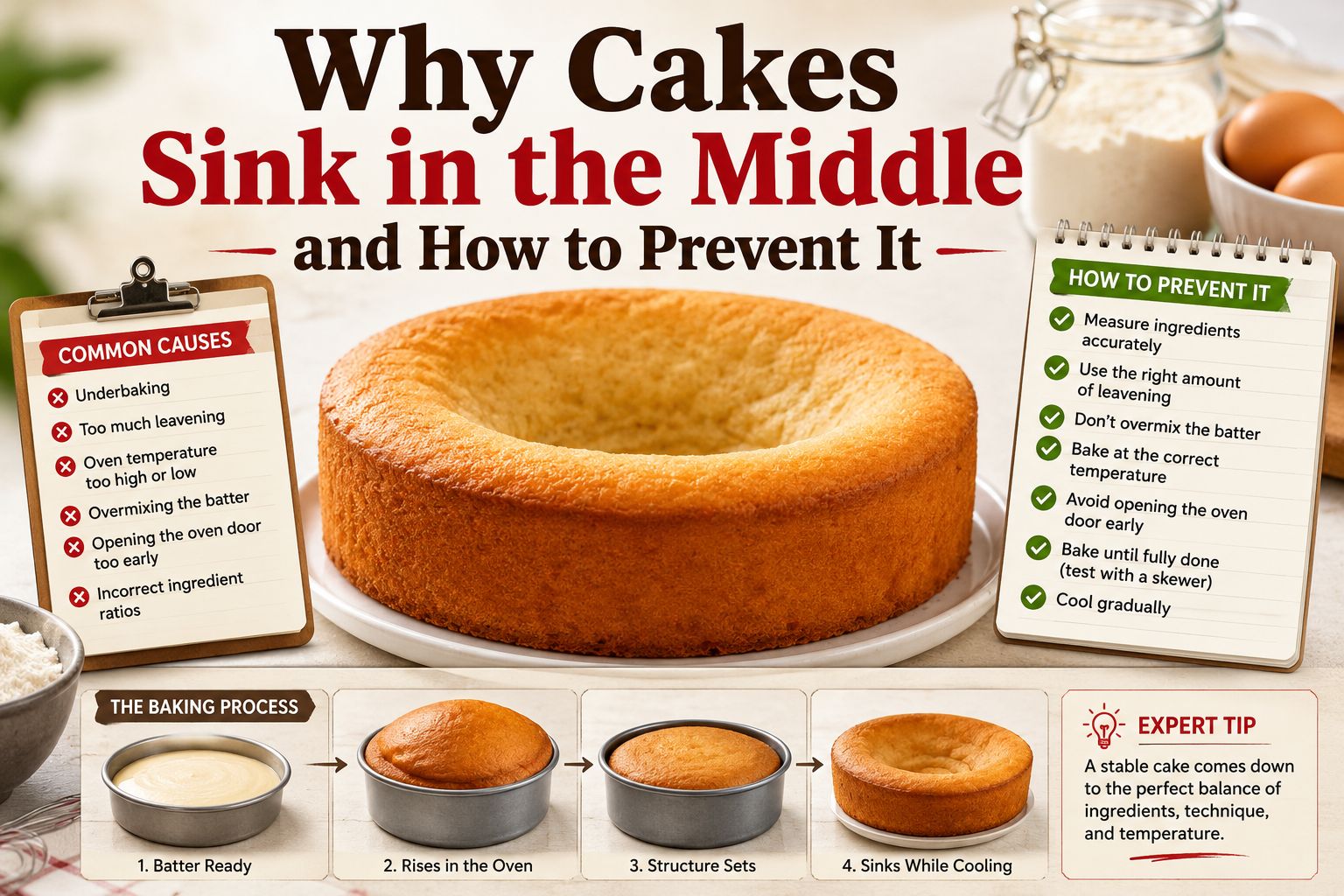
Few baking disappointments are as frustrating as pulling a beautifully risen cake from the oven only to watch the center collapse into a crater as it cools. I have experienced this countless times throughout my years of recipe testing, and it remains one of the most common problems home bakers encounter. The cake may look perfect through the oven door, with a golden surface and impressive height, only to sink dramatically moments later.
What makes this issue particularly confusing is that a sunken cake can result from several different causes. Sometimes the problem begins during mixing, while other times it originates from incorrect oven temperatures, ingredient imbalances, or even opening the oven door at the wrong moment. The visible collapse is simply the final symptom of a structural failure that occurred earlier in the baking process.
In my kitchen, I approach cake baking as a balance between chemistry and technique. Cakes rely on carefully timed reactions involving proteins, starches, fats, sugars, and leavening agents. When one of these elements falls out of balance, the cake’s internal structure cannot support itself.
By the end of this guide, you will understand exactly why cakes sink in the middle, how cake structure develops during baking, and the practical techniques that consistently produce tall, evenly risen cakes with stable centers.
The Underlying Science
To understand why cakes sink, it helps to know what happens inside the batter during baking. A cake begins as a liquid foam containing water, fat, sugar, proteins, starches, and trapped air bubbles. As heat enters the batter, several critical transformations occur simultaneously.
The first major event involves leavening. Chemical leaveners such as baking powder and baking soda produce carbon dioxide gas, while air incorporated during mixing expands as it warms. These gases create thousands of tiny pockets that push the batter upward. During the early stages of baking, the cake is essentially inflating like a balloon.
At the same time, proteins from eggs and flour begin to coagulate, meaning they unfold and bond together into a stable network. This protein framework acts like the steel beams of a building. Without sufficient protein structure, the cake may rise temporarily but lack the strength to hold its shape once removed from the oven.
Starch granules in flour also play a vital role. As the batter reaches temperatures typically above 180°F (82°C), starch gelatinization occurs. Gelatinization is the process in which starch absorbs water, swells, and thickens, helping transform a fluid batter into a solid cake crumb. The combination of coagulated proteins and gelatinized starch creates the permanent structure that supports the cake.
Sugar introduces another layer of complexity. While sugar improves tenderness and moisture retention, excessive amounts can weaken structure by delaying protein coagulation and starch gelatinization. This means the cake may continue expanding before its framework becomes strong enough to support itself.
Temperature control is equally important. If the exterior sets too quickly due to excessive oven heat, the center may remain underdeveloped. Conversely, if the oven is too cool, the structure may never fully set before the expanding gases escape. In either scenario, the center loses support and collapses.
A sunken cake is therefore not merely underbaked. It is often the result of a mismatch between expansion and structure formation. The gases rise successfully, but the protein and starch framework fails to stabilize them before cooling begins.
Step-by-Step Technique Guide
Preventing a sunken cake starts long before the batter enters the oven. Ingredient preparation is the first critical step. I always bring eggs, butter, and dairy ingredients to room temperature. Uniform temperatures promote smoother emulsification, which is the stable blending of fat and water components. A properly emulsified batter traps air more effectively and bakes more evenly.
Accurate measurement is equally important. Flour should be weighed whenever possible rather than scooped directly from the container. Excess flour can create a dense cake, while too little flour reduces structural strength. Likewise, baking powder and baking soda should be measured carefully because excessive leavening often causes dramatic rises followed by equally dramatic collapses.
Mixing technique deserves close attention. During the creaming method, butter and sugar should be beaten until light and fluffy but not excessively whipped. Proper creaming incorporates microscopic air bubbles that act as expansion sites during baking. Overmixing after flour is added, however, develops excess gluten, creating an uneven crumb and increasing the risk of structural instability.
Pan selection matters more than many bakers realize. Dark pans absorb heat rapidly and can cause the cake edges to set before the center catches up. Light-colored metal pans generally promote more even heat distribution. I also avoid filling cake pans beyond two-thirds full because excessive batter depth slows heat penetration into the center.
Oven management is another major factor. An oven thermometer is one of the most valuable baking tools available. Many household ovens run 15 to 25 degrees Fahrenheit hotter or cooler than their displayed settings. A cake baked at an incorrect temperature may rise improperly even if the recipe itself is flawless.
During baking, avoid opening the oven door during the first two-thirds of the bake time. Every opening causes a temperature drop and disrupts the delicate process of gas expansion and structural setting. Once the cake appears nearly done, test for doneness by inserting a skewer near the center. It should emerge with only a few moist crumbs attached rather than wet batter.
After baking, allow the cake to cool gradually. Sudden temperature changes can stress the internal structure, especially in delicate sponge-style cakes. Proper cooling helps the starch and protein network finish stabilizing before the cake is handled.
Comprehensive Troubleshooting Section
One of the most common causes of a sunken center is underbaking. The cake may appear golden and fully risen, but the internal structure has not completed protein coagulation and starch gelatinization. If you notice a slightly unstable center near the end of baking, continue baking in short intervals of three to five minutes while monitoring closely.
Excess leavening creates another frequent problem. Too much baking powder or baking soda produces rapid gas expansion. The cake rises beyond what its structure can support and eventually collapses under its own weight. If your cakes consistently develop large domes before sinking, reevaluate your leavening measurements.
Overmixing can also contribute to collapse. Excessive mixing after flour addition develops gluten, creating a tougher network that may expand unevenly and trap large air pockets. These pockets can burst during cooling, causing the center to deflate.
Opening the oven door prematurely is particularly damaging for delicate cakes such as chiffon cakes or sponge cakes. A sudden drop in temperature reduces gas pressure inside the batter before the structure has set. If the center appears to fall immediately after checking the cake, temperature disruption is a likely cause.
Incorrect ingredient ratios can create chronic problems. Excess sugar, excessive liquid, or insufficient flour weakens the cake’s framework. If a recipe repeatedly produces sinking despite correct baking technique, examine the formulation itself rather than assuming user error.
When a cake has already sunk, it is not necessarily ruined. For casual serving, the surface can often be leveled with a serrated knife and covered with frosting. A sunken cake may still have excellent flavor and texture. The collapse primarily indicates a structural issue rather than a food safety concern, provided the cake was eventually baked to a safe internal doneness.
Frequently Asked Questions
Why does my cake rise perfectly in the oven and then sink while cooling?
This usually indicates that the cake expanded successfully but did not develop enough internal structure to support itself. Underbaking is the most common cause, although excessive leavening, too much sugar, or inaccurate oven temperatures can produce the same result. The collapse becomes visible during cooling because expanding gases contract as temperatures drop.
Can an oven that is too hot cause a cake to sink?
Yes. Excessive heat causes the outer portions of the cake to set rapidly while the center remains underdeveloped. The cake may appear fully baked because the surface looks finished, but the middle lacks the protein and starch structure needed for support. As cooling begins, the weak center collapses.
Is it possible to rescue a cake that is starting to sink while still baking?
Sometimes. If you notice that the center appears unstable but is not fully collapsed, continue baking without opening the oven repeatedly. Additional baking time may allow the internal structure to finish setting. Once a cake has significantly collapsed, however, the structural failure has already occurred and cannot be completely reversed.
Why do dense cakes sometimes sink even though they seem fully baked?
Dense cakes often contain high levels of moisture, fat, or sugar. These ingredients slow structural development and place greater weight on the cake’s framework. A dense cake may pass a skewer test while still lacking sufficient strength in the center. Extended baking time, adjusted ingredient ratios, or reduced batter volume may solve the issue.
Does altitude affect cake sinking?
Absolutely. At higher elevations, lower atmospheric pressure allows gases to expand more rapidly. Cakes rise faster and may overexpanded before their structure stabilizes. Bakers at high altitude often need adjustments to leavening, liquid content, baking temperature, and baking time to maintain proper structure and prevent collapse.
For more authentic recipes : duarecipes.com