
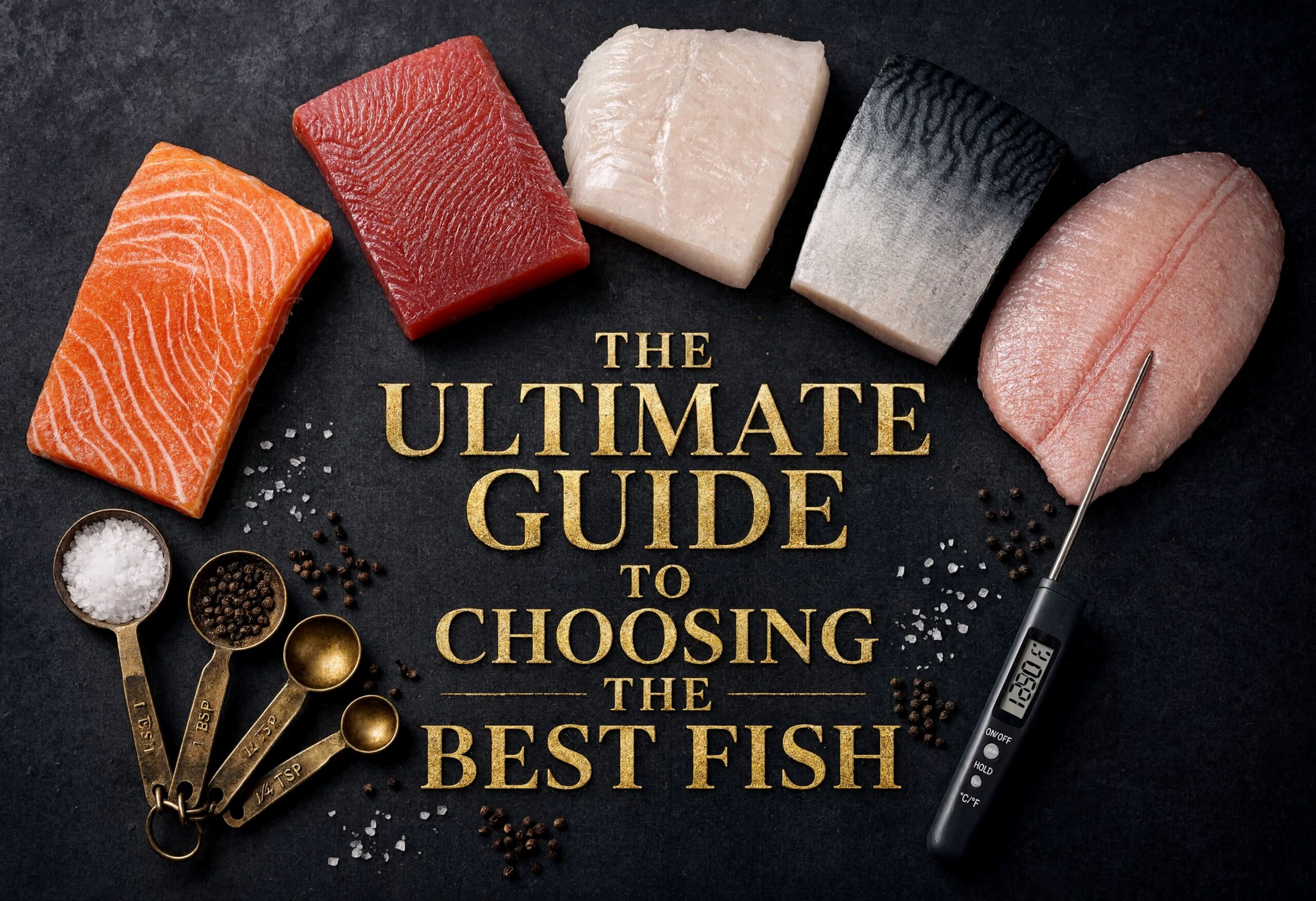
As a culinary scientist who has spent 15 years standing over hot stoves, filleting thousands of fish, and scraping more failed attempts into the trash than I care to admit, I can tell you with absolute certainty that the number one kitchen tragedy I witness is a beautiful piece of fish treated like an afterthought. I’ve seen $40 a pound halibut pounded into a dry, fibrous mat because someone treated it like chicken breast. I’ve watched delicate flounder disintegrate into a sticky scramble on a grill grate because nobody considered its structural integrity. Here’s the hard truth you won’t find on a glossy recipe card: a recipe that simply calls for “white fish” is setting you up for failure. The biological architecture of a fast-swimming pelagic tuna has absolutely nothing in common with a lazy, bottom-dwelling flounder, and expecting them to behave identically under heat is a chemical impossibility. By the time you finish reading this guide, you will possess a mental framework that allows you to look at any fish counter, instantly analyze the muscle structure and fat content of a species, and match it flawlessly to the cooking method that will elevate it, rather than destroy it.
The Underlying Science
The internal logic of seafood selection is rooted entirely in a protein matrix called myosin and the intramuscular fat structure. I teach my students to abandon the oversimplified “fat vs. lean” dichotomy and instead classify fish by their myotome architecture essentially, the size and thickness of the muscle flakes and the collagen content holding those flakes together. A fast-cruising pelagic predator like yellowfin tuna possesses dense, tightly packed myotomes designed for sustained speed. These muscles are heavily vascularized with myoglobin (giving them that ruby hue) and are exceptionally high in heat-stable proteins that maintain integrity even when the center barely touches 115°F. Contrast this with a reef-dwelling hogfish or a cold-water cod; these fish employ a “sprint and rest” locomotion strategy. Their muscle fibers are short, delicate, and separated by thin, weak sheets of collagen that require minimal thermal energy to denature. When you subject a fragile, short-fibered fish to the violent, high-heat environment of a broiler, the interstitial water between those flakes flash-boils almost instantly. The resulting vapor pressure forces the flake layers apart faster than they can contract, pushing out moisture and leaving behind a chalky, ruptured protein structure. You also must account for the thermal transition of collagen Type I, the primary connective tissue in fish. Unlike the collagen in beef shank that requires hours at 200°F to hydrolyze into gelatin, fish collagen begins to break down at a shockingly low 120°F and dissolves completely by 140°F. This is the exact mechanism that makes a slow-roasted salmon fillet unctuous and buttery rather than that chalky, white-albumin-oozing disaster you get from a hot pan. You aren’t cooking the fish; you are managing the viscosity of its internal gelatin matrix. When I select fish for a ceviche, I’m calculating the density of the muscle fibers to gauge acid penetration speed. When I plan a braise, I’m looking for high-collagen cuts like monkfish tail or grouper throat that can withstand prolonged thermal stress and actually gain succulence from it. Understanding that these are not just ingredients but biological structures with distinct mechanical thresholds immediately shifts your hit rate from a coin flip to surgical precision.
Step-by-Step Selection Framework
My selection process in the kitchen doesn’t start with a recipe; it starts with an honest visual and tactile biopsy at the fish counter, followed by a ruthless matching algorithm. First, disregard the fillet for a moment and assess the whole fish if possible. I look for an active slime coat—that clear, viscous mucoprotein layer that signals recent harvest and proper icing. In whole fish, the eye must possess a convex, crystalline dome structure, not a flat, sunken crater. Once you’re handling a fillet, press firmly into the thickest anterior portion of the muscle with your index finger. You are testing hysteresis, the material’s ability to return to its original state. If the indent remains like a thumbprint in memory foam, the protein structures are already beginning to enzymatically degrade and the fillet will leak copious moisture during cooking, regardless of your technique. The smell should register as a clean, sea-breeze minerality, or in freshwater fish, a scent of wet stone and cucumber. Any ammonia, or the metallic tang of oxidative rancidity, is a non-negotiable red flag signaling that trimethylamine oxide has already decomposed into trimethylamine.
With quality assured, I mentally slot the fish into a thermal compatibility matrix based on the cooking method’s heat intensity and the fish’s flake profile. For raw and acid-cured preparations, you require a hyper-dense, low-fat species with a tight myotome seal. Yellowfin and bluefin tuna, Japanese hamachi, and sustainably farmed kanpachi are the benchmarks here because their dense muscle resists acid penetration, allowing the citrus in a tiradito to cure the exterior while the interior remains a cool, silky, translucent pink. For gentle, uniform cooking methods like poaching, court-bouillon steaming, or low-temp butter baking (below 175°F), I reach exclusively for fragile, cool-water species with wide, delicate flakes. True cod, haddock, and lake whitefish fit this niche perfectly, as their albumin coagulation point is low enough that the gentle radiant heat sets the flesh into tender, distinct laminae without the protein spasms that high heat causes. Pan-searing is where the stakes get exponentially higher. This method demands a species with robust connective tissue and a skin that is thick enough to convert into a glassy, shatterable chip. Black sea bass, Arctic char, and a skin-on strip of red snapper are my workhorses. The technique relies on establishing a thermal barrier with the hot oil, which instantly begins rendering subcutaneous fat into the dermis, physically pushing the water out and turning the collagen into a crisp latticework. If you try to pan-sear a water-logged, flaky tilapia fillet, the sheer volume of purge water hits the hot oil, instantly dropping the pan temperature below the Maillard threshold and effectively steaming the fillet in its own grey, albumin-heavy liquid. For extreme, dry, radiant heat from a 500°F broiler, your only option is a high-fat, densely fleshed species. I’m talking about swordfish, mahi-mahi, and the thickest collars of larger grouper. The intramuscular fat in these species acts as a latent heat absorber, protecting the protein matrix from denaturing too rapidly. Finally, for low-and-slow smoking, I avoid lean wild salmon that will turn to jerky in an hour and specifically seek out the glyceride-rich belly strips of farmed steelhead trout or king salmon, which maintain a velvety internal texture even after two hours of cold smoke followed by a gentle hot finish.
Troubleshooting the Most Common Fish Fatalities
Even armed with the right species, execution can slip. When your pristine snapper skin stubbornly refuses to crisp and instead welds itself irrevocably to the stainless steel pan, you’re facing a moisture displacement failure. In this scenario, you likely salted the skin too early. The salt drew moisture to the surface through osmotic gradient, and when the wet fillet hit the oil, it instantly cooled the fat below the 320°F threshold required for rapid dehydration. Do not try to pry it; instead, kill the heat and add a splash of warm stock or wine directly to the pan to create a quick braising steam. The liquid will work itself under the skin’s interface, releasing the delicate proteins through gentle convection rather than violent force. You’ll lose the crispness but rescue a beautifully soft, skinless fillet for flaking. The dreaded white albumin exudate pooling on your salmon is a different beast entirely—it’s myosin protein that has violently coagulated because your heat source was too aggressive relative to the fillet’s thickness. If you see it weeping onto the surface during a pan-sear, immediately remove the pan from the burner and, using a pastry brush, gently lift the white deposits away while basting the surface with the surrounding warm butter or oil. The fat will temporarily re-coat and insulate the broken protein channels, halting further seepage and restoring a degree of visual finesse. For the tragedy of a poached fish that has turned into dry, floating clouds in the broth, the water temperature has almost certainly exceeded the 160°F danger zone where muscle fibers contract violently and squeeze out moisture. Immediately transfer the fractured pieces to a bowl containing room-temperature clarified butter or a high-quality olive oil. The lipids will infiltrate the gaps left by the contracting protein, replacing the lost water with fatty mouthfeel. You haven’t technically rehydrated it—you’ve performed a structural lipid replacement to restore sensory juiciness. If your grilled mahi-mahi has welded itself to the grate and is tearing as you try to flip it, the glycoproteins haven’t had enough time to char and self-release. Close the grill lid to kill the oxygen flow and lower the grate’s surface temperature slightly, allowing the flesh to continue cooking until the carbonized contact points naturally release from the metal. If you try to force the flip before this natural release occurs, you’ll leave the entire browned crust stuck to the grate and be left with a steamed, naked chunk of protein.
Frequently Asked Questions
Can I reliably use frozen fish if the recipe requires a hard sear, or will it always leak water?
The freezing process creates ice crystals that puncture cell walls, so a commercially frozen fillet will indeed purge more liquid upon thawing. However, I vastly prefer individually quick-frozen (IQF) fillets from a high-pressure processing facility over “fresh” fish that has been sitting on a display case drip pad for three days. The technique to salvage a sear is to thaw the fillet completely in the refrigerator overnight on a raised rack with a heavy salt and sugar dry brine (1:1 ratio) coating the flesh. This draws out the myowater, replaces it with a concentrated protein solution, and chemically changes the surface tension, allowing it to sear without a watery steam bath.
When is the distinct “fishy” smell actually a feature I should look for, rather than spoilage?
This is a fantastic nuance. We associate that smell with decay because of trimethylamine, but if you’re dealing with a high-fat pelagic species like fresh, never-frozen mackerel or bluefish, an immediate, sharp, metallic, and almost cucumber-like aroma is the scent of volatile omega-3 fatty acids in their prime oxidative state, not rotting flesh. These species have a naturally aggressive liver enzyme activity that produces a stronger aroma immediately upon death. The key differentiator is time: it should hit your nose as a sharp, clean, slightly tinny scent that dissipates within seconds. If the smell lingers as a heavy, cloying, stale odor that coats your nasal passages, that’s bacterial spoilage. In Japanese cuisine, this pristine initial pungency is prized in cured preparations like shime saba where the vinegar tames the oil, transforming that metallic edge into pure, savory depth.
How do I handle a monster fillet of halibut that’s an inch thick on one end and paper-thin on the tail end?
Do not, under any circumstances, apply uniform heat. This is a geometry problem requiring a physical solution. I fold the thin tail flap underneath itself to create a double-ply thickness and secure it with a toothpick threaded horizontally like a skewer, creating an even-density log. You can also stagger the cooking zones: place the thick, anterior portion over the direct flame of a grill or the center of the pan while positioning the thin tail end toward the cooler edge, effectively creating two distinct thermal zones on a single piece of protein to account for the mass discrepancy.
For authentic article duarecipes.com