
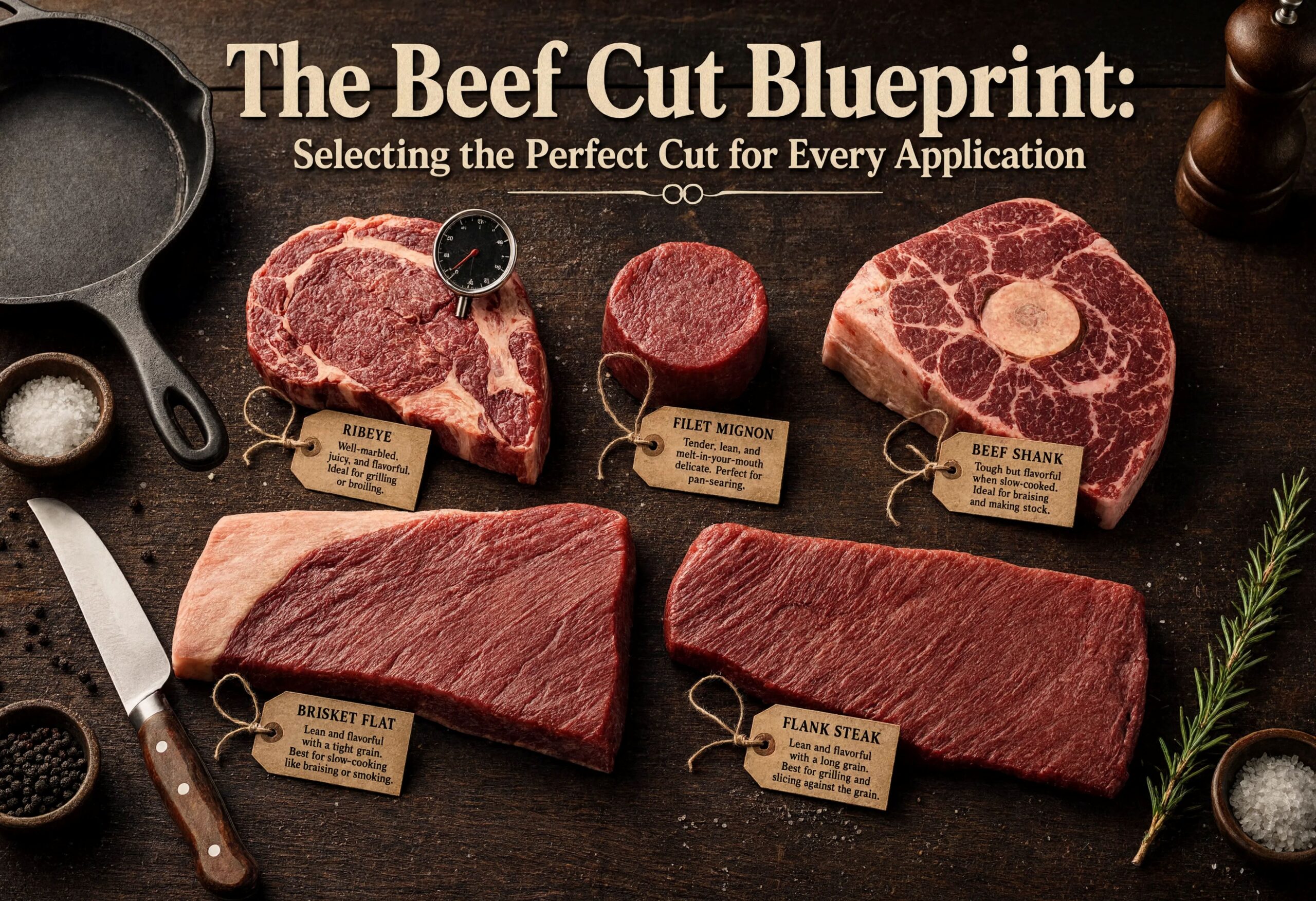
I still remember the frustration of my early kitchen days purchasing a gorgeous, thick beef shank, expecting a tender steak, and ending up with something closer to a leather shoe. After fifteen years of professional cooking and culinary research, I’ve learned that mastering beef isn’t about having the most expensive ingredients; it’s about understanding the relationship between muscle structure, connective tissue, and heat application. This guide will transform how you approach beef, giving you the scientific foundation and practical confidence to select the right cut for every cooking method, every time.
The Science of Muscle and Heat
To understand beef cuts, we must first understand the animal’s anatomy. The most tender cuts come from muscles that do the least work specifically, those along the backbone . Think of the rib and loin areas; these muscles are primarily “along for the ride,” supporting the animal’s structure without bearing significant weight or performing repetitive motion . Conversely, the heavily exercised muscles in the shoulder (chuck) and leg (round) develop dense connective tissue and tough muscle fibers .
This is where culinary science becomes practical. Connective tissue primarily consists of collagen, a structural protein. When exposed to moist heat over an extended period, collagen hydrolyzes breaking down into gelatin . This transformation is why a tough brisket becomes meltingly tender after hours in a braising liquid . The gelatin also contributes to the rich, mouth-coating texture we associate with excellent stews and pot roasts.
Marbling the intramuscular fat serves a different purpose. These white flecks of fat melt during cooking, basting the meat from within and creating pockets of juiciness . Cuts with significant marbling, such as ribeye, remain succulent even with high-temperature cooking methods . Leaner cuts like those from the round lack this internal protection, making them susceptible to drying out .
The Professional’s Approach to Selection and Technique
Let me share my methodology for selecting and preparing beef based on how I evaluate the cut in the butcher case. The initial observation is crucial: examine the meat’s color, texture, and fat distribution .
For quick, high-heat applications like grilling or pan-searing, I immediately gravitate toward the tenderloin, ribeye, and strip loin. These cuts, particularly the filet mignon from the tenderloin, are prized for their tenderness . I cook them over direct, high heat (around 450–550°F) to develop a flavorful crust while keeping the interior medium-rare . For a bone-in ribeye, I’ll use a two-zone grilling method: searing directly over high heat, then moving to indirect heat to allow the center to reach the desired temperature without burning the exterior .
Conversely, when planning a stew or pot roast, I specifically select chuck, brisket, or shank . These cuts contain abundant collagen, which, when broken down, results in tenderness and a rich, savory sauce. I always brown the meat thoroughly before adding liquid—a step that triggers the Maillard reaction, creating complex flavor compounds that are fundamental to a deep, satisfying dish .
Never overlook the value of flavor. Rump cuts, while not as tender as sirloin or fillet, often deliver a more intense beef flavor . I frequently use rump for grilling or stir-frying, but I’m meticulous about slicing it thinly against the grain to maximize tenderness. Flank steak is another flavor powerhouse, but its coarser muscle fibers demand proper technique. I recommend marinating it to enhance moisture and texture, grilling to medium-rare, and slicing at a steep angle against the grain .
Troubleshooting Common Beef Mishaps
Even with experience, challenges arise. The primary issue I see is toughness. If you’ve just removed a steak from the grill and it’s tough, the most probable culprit is a mismatch between the cut and the cooking method. A round steak cooked to medium-rare will be challenging to chew because its collagen hasn’t had time to break down. If you find yourself in this situation, the rescue is a “rescue braise” returning the meat to the pan with a flavorful liquid and simmering it gently until it becomes tender. This might take one to two hours, but it will salvage the meal.
Dryness is another common failure, particularly with lean roasts like eye of round . This occurs when the meat’s internal temperature exceeds 150°F, causing the muscle fibers to contract tightly and expel moisture. If your roast is dry, serve it with a generous amount of sauce or gravy to compensate. For future attempts, I strongly recommend using a meat thermometer to ensure you pull the roast at 125°F for rare or 135°F for medium-rare, allowing for carryover cooking during the rest.
A dry burger signals that your meat was too lean or was overworked. I recommend using chuck for burgers because its 80/20 meat-to-fat ratio provides the necessary juiciness . Overhandling the meat compacts the proteins, resulting in a dense, tough patty. Treat the meat gently, form loose patties, and cook them to medium for optimal texture.
Frequently Asked Questions
What is the absolute best cut for a beginner to cook for a special occasion?
The ribeye is widely considered the most forgiving and rewarding cut for the home cook . Its generous marbling provides a cushion against slight overcooking. I recommend cooking it in a cast-iron skillet on the stovetop, finishing it in a 400°F oven, and using an instant-read thermometer to pull it at 130°F for a perfect medium-rare.
Why is my brisket still tough after many hours of cooking?
Brisket is notorious for its stubbornness. It contains an exceptionally high amount of collagen that requires prolonged exposure to moist heat to break down . If it’s tough, it simply hasn’t cooked long enough. Continue cooking it in a covered vessel with liquid at a temperature between 275°F and 325°F until a skewer slides in with little resistance. For brisket, the breakdown of collagen to gelatin doesn’t occur on a strict timeline; it’s a process that demands patience.
Is there a budget-friendly cut that tastes like a premium steak?
The flat iron steak, a cut from the chuck primal, is one of the best-kept secrets in the butcher case . It is the second most tender cut of beef, behind the tenderloin, yet it is often significantly more affordable. I recommend cooking it quickly over high heat like a premium steak, slicing it thinly against the grain.
What does “against the grain” actually mean?
The grain refers to the direction in which the long muscle fibers run through the meat. If you slice parallel to these fibers, you will be cutting the meat into long pieces that your teeth cannot easily break apart. To ensure tenderness, you must cut perpendicular to these fibers, effectively shortening them and making each bite easier to chew . This is especially important for cuts with prominent fiber lines, like flank and skirt steak .
For more authentic articles : duarecipes.com