
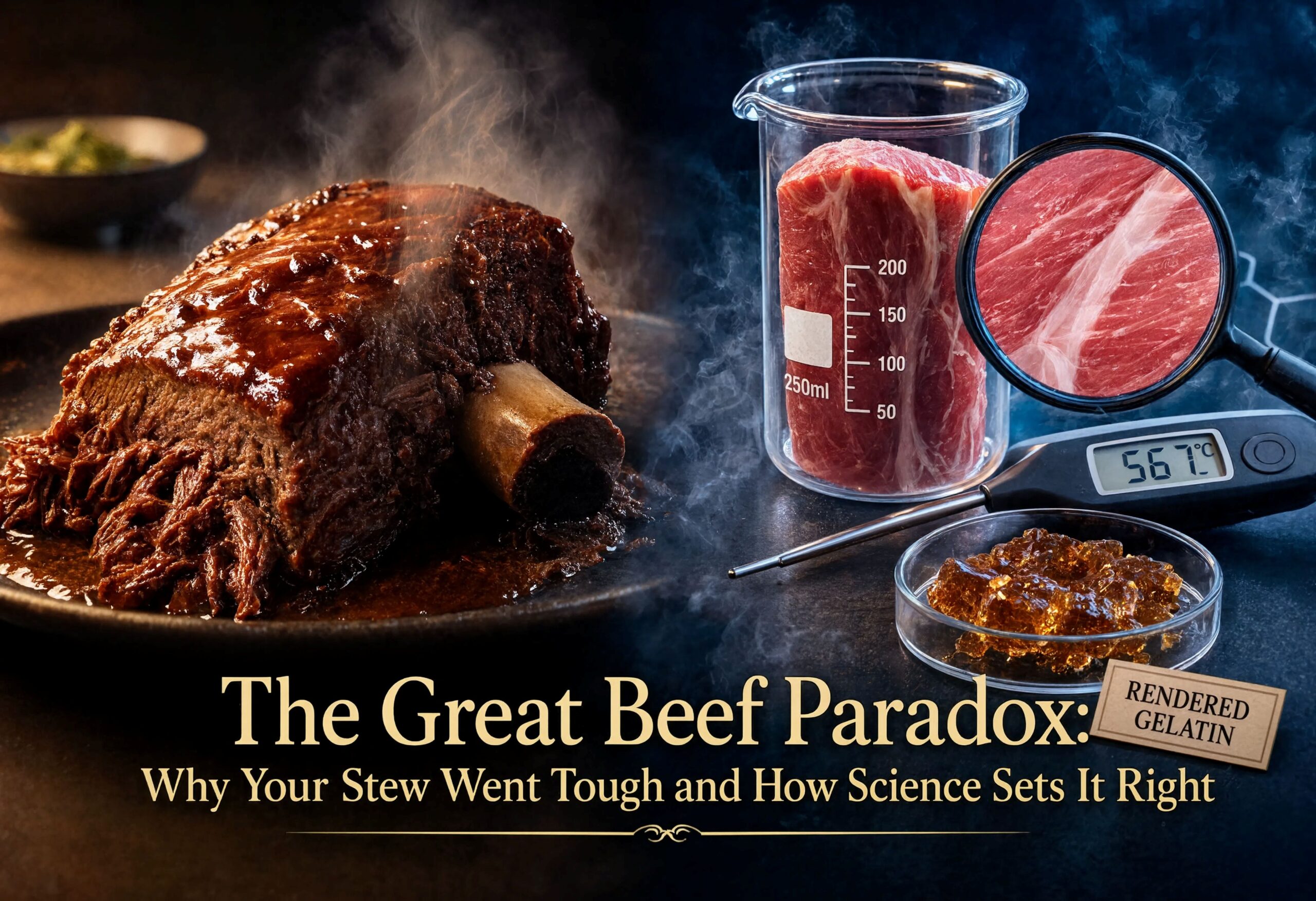
There are few disappointments in the kitchen quite like the one that greets you after hours of patient braising. You’ve invested time, love, and a good bottle of wine into what you hoped would be a meltingly tender pot roast, only to be met with meat that resists your fork like rubber. It’s a culinary betrayal that has perplexed home cooks for generations. I know this frustration intimately; in my 15 years of professional cooking and recipe development, I’ve been on the losing end of this battle more times than I care to count, standing over a pot and wondering where I went wrong.
The answer isn’t about a lack of love or a missing secret ingredient; it’s rooted firmly in molecular science. We’re not just cooking; we’re conducting a series of complex chemical reactions. By the end of this masterclass, you will no longer be at the mercy of your beef. You will understand the fundamental changes occurring within that chunk of protein and, more importantly, how to manipulate them to achieve guaranteed succulence. We’re here to unravel the mystery of why beef turns tough, and I promise you, by the time we’re done, you’ll be armed with the culinary intelligence to never suffer a dry, chewy disaster again .
The Architecture of Meat: Understanding the Players
To master a technique, you must first understand your medium. A piece of beef is not a homogeneous block; it is an intricate web of water, proteins, and connective tissue, meticulously assembled to perform specific functions in the living animal. Think of it as a highly organized biological machine. The primary structural components are the muscle fibers. These are long, slender cells, each packed with even finer filaments of two crucial proteins: actin and myosin .
In a living animal, these proteins slide past each other to create movement, but after slaughter, a fundamental shift occurs. Without blood flow to deliver oxygen and remove waste, the muscle cells exhaust their energy supply, a molecule known as ATP. The cell is forced to generate energy through a less efficient process, producing lactic acid as a byproduct. As ATP runs out, the actin and myosin filaments lock permanently together, a state we call rigor mortis . This is the first point of toughness, and while aging post-slaughter will allow natural enzymes to break this cross-linking down and tenderize the meat, our cooking methods will ultimately determine the final texture .
The second key player is connective tissue, primarily a protein called collagen. This is the biological “glue” that holds the muscle fibers together and attaches them to the bone . It’s what makes a working muscle like a shoulder or shank tougher than a tenderloin, which does very little work. When heated, these two systems react in opposite ways, creating the central dilemma of cooking beef.
The Clash of Proteins: The Science of Heat
Here lies the crux of the issue. The two primary proteins in beef, myofibrillar proteins (actin and myosin) and collagen, have conflicting responses to heat.
Myofibrillar proteins begin to denature and coagulate, essentially tightening and squeezing out moisture, at relatively low temperatures. As the internal temperature of the meat rises past 140°F (60°C), these proteins contract and expel the water held within the muscle fibers . This is why a steak cooked to well-done is invariably drier and tougher than one cooked to medium-rare. The liquid that is being expelled is the juice, and the contracting muscle fibers become rigid.
Connective tissue collagen, on the other hand, is initially tough and resilient. However, when subjected to low and slow, moist heat, it undergoes a miraculous transformation. Starting at around 160°F (71°C) and progressing with time, the collagen dissolves into gelatin . This process is the foundation of every great braised dish. The gelatin not only softens the meat but also adds a rich, silky mouthfeel to the sauce.
So, the challenge is clear. You are caught between the twin pressures of toughening muscle fibers and tenderizing collagen. How do you get one to break down before the other turns your meal into shoe leather? You must play to the strengths of your chosen cooking method, and this is where the decision-making begins before you even heat the pan.
A Chef’s Methodology: Two Paths to Success
In my kitchen, the approach to cooking beef is determined by one simple factor: the role of the cut. This isn’t about “good” or “bad” meat; it’s about selecting the right tool for the job.
Path 1: The Fast Track for Tender Cuts
For cuts with little connective tissue—think ribeye, strip loin, or tenderloin—you are dealing primarily with muscle fibers. The goal is to cook them quickly, preserving the moisture, and to stop the cooking process before the internal temperature exceeds 125-130°F (52-54°C) for a perfect medium-rare . High heat is your friend here, used to develop a savory, complex crust through the Maillard reaction. This happens rapidly on the surface while the interior remains relatively cool and juicy. Let the meat rest after cooking, allowing the proteins to relax and reabsorb some of the moisture that was forced to the surface.
Path 2: The Marathon for Tough Cuts
For working muscles like chuck, brisket, or shank, dense with collagen, the “low and slow” mantra is an absolute scientific necessity. These cuts cannot be rushed. If you attempt to grill a brisket like a steak, you will be left with a charred, impossibly tough, and dry piece of meat. The muscle fibers will have contracted, and the connective tissue will not have had time to convert to gelatin. Instead, you must use moist heat—braising or stewing—to gently coax the collagen into dissolving . This is a process that unfolds over hours, not minutes. By cooking at a gentle simmer, ideally between 284°F and 320°F in the oven, you allow the collagen to break down into gelatin, which in turn lubricates the now-loose muscle fibers, resulting in the sublime, fork-tender texture we all crave . It’s a marathon, not a sprint, and high heat is the enemy of this transformation.
Troubleshooting in Real Time
Even with the best intentions, things can go awry. Here’s how to diagnose and rectify common pitfalls:
- The Roast is Tough and Dry (“I cooked it too fast!”): This is the classic failure for a pot roast or stew. The internal temperature spiked too quickly, causing the muscle fibers to seize and expel their moisture before the collagen could break down. The process is not yet complete. You can attempt a rescue by adding more flavorful liquid, such as stock or broth, covering the pot, and returning it to a low oven for an extended period. The goal is to create a steamy, moisture-rich environment that will continue to break down the remaining collagen and rehydrate the meat .
- The Roast is Dry but Not Tough (“I overcooked it!”): This is trickier. If the collagen has fully converted to gelatin, leaving the meat feeling somewhat dry but not impossibly chewy, the primary loss was moisture. The gelatin is present but may have squeezed out. While you can’t put the moisture back in, you can serve the shredded, tender meat with a generous amount of the rich sauce it was cooked in. The gelatin in the sauce will provide the sensation of moisture and richness.
- The Meat Feels “Mushy”: This indicates the cooking process went too far, often due to a boiling temperature. The muscle fibers have been completely broken down and disintegrated. There is no saving the texture, but the flavor is likely still excellent. Shred the meat and use it as a base for a sauce-based dish like a ragu or chili, where the texture is less noticeable.
- The Meat is Chewy and Stringy (“I didn’t cook it long enough!”): You have effectively jumped the gun. The collagen is still intact, and the muscle fibers are tight. The only path forward is to continue cooking it low and slow. Add more liquid if it’s running dry, cover, and be patient.
Your Definitive Q&A
1. Is it true that searing a roast “seals in the juices”?
No, this is a classic culinary myth. Searing is a critical step, but not for moisture retention. I do it because the intense heat creates a deeply flavorful crust through the Maillard reaction, a chemical process between amino acids and reducing sugars. This brown crust provides a depth of flavor that is essential for a rich braise. The meat will lose moisture whether it’s seared or not; the flavor benefit, however, is irreplaceable .
2. Can I use a marinade to help tenderize a tough cut?
Yes, but it’s crucial to understand the mechanism. Marinades containing acids (like lemon juice, vinegar, or wine) can help denature proteins on the surface of the meat, making it softer . However, acids do not penetrate deeply into a large roast . For a tough cut, a marinade can add a lovely layer of flavor and surface tenderness, but it’s no substitute for the slow, moist heat required to break down the internal collagen.
3. Why does my beef always turn out tough when I use a slow cooker?
This is a very common problem. The issue is often not time, but temperature. Many slow cookers boil their contents, even on the “low” setting, which is too aggressive. Boiling causes the muscle fibers to contract rapidly and violently, squeezing out moisture before the collagen can dissolve. For a successful pot roast, you need a gentle simmer, where bubbles just lazily break the surface of the liquid. If your slow cooker runs hot, the oven at a stable 300°F is a much more reliable option .
4. What is the best way to slice a cooked roast for maximum tenderness?
The orientation of your knife is paramount. All muscle fibers run in a single direction, and that is the “grain.” When you slice a piece of meat, you are cutting through thousands of these fibers. To ensure maximum tenderness, you must slice perpendicular to the grain . This shortens the muscle fibers, making them much easier to bite through. Think about cutting a bundle of drinking straws. It’s much easier to bite through them if they are cut crosswise into short pieces than if you try to bite through them lengthwise. This simple rule can dramatically improve the eating experience of even a slightly tougher cut.
For more authentic articles : duarecipes.com